5 February 2026
What to Know:
- XRP wallet addresses are increasing despite a 49% price drop, signaling strong long-term accumulation and network utility.
- Market focus is shifting toward infrastructure projects that solve liquidity fragmentation and cross-chain execution issues.
- LiquidChain unifies Bitcoin, Ethereum, and Solana liquidity, eliminating the need for risky bridges and wrapped assets.
- Smart money is rotating into early-stage utility, with over $526k already raised for the new L3 protocol.
The market is flashing a classic divergence signal, one that usually separates tourists from veterans.
XRP, the token underpinning the Ripple network, has retraced significantly, dropping 49% from its recent highs. Ugly? On the surface, yes. But on-chain data tells a completely different story. Wallet addresses aren’t capitulating; they’re multiplying.
Historically, price and network growth move in tandem. When charts bleed, retail investors typically run for the exit, causing active addresses to flatline. The current scenario flips that logic.
The spike in unique wallet addresses suggests that while speculative capital flees, long-term accumulation is actually accelerating. It’s a textbook ‘coiled spring’ setup, network utility is outpacing valuation.
 This resilience points to a deeper trend: a hunger for infrastructure that moves actual value rather than just speculation. Whales seem to be ignoring the short-term noise to focus on the asset’s utility in cross-border settlements.
But while XRP handles fiat bridging, a massive bottleneck remains in decentralized finance (DeFi). Liquidity is still fractured across isolated blockchains. Traders watching the XRP infrastructure play are now pivoting to new protocols designed to fix this mess.
One such project, LiquidChain ($LIQUID), is gaining traction for its ambitious Layer 3 solution that unifies liquidity across the industry’s giants.
LiquidChain Unifies Fragmented DeFi Across Bitcoin and Ethereum
The biggest friction point in crypto today isn’t speed, it’s isolation. Try using Bitcoin on Solana without a headache of bridges and wrapped assets; it’s a nightmare. That fragmentation traps capital and kills efficiency.
LiquidChain ($LIQUID) tackles this by positioning itself as the ‘Cross-Chain Liquidity Layer,’ an L3 infrastructure designed to fuse Bitcoin, Ethereum, and Solana into a single execution environment.
This changes the game for user experience. Instead of juggling three wallets and bridging manually, LiquidChain uses a ‘Deploy-Once’ architecture. Developers build an app once, and it instantly taps into liquidity and users from $BTC, $ETH, and $SOL simultaneously.
Under the hood, a Cross-Chain Virtual Machine (VM) handles the complex settlement logic, giving users single-step execution.
For the market, this represents a shift from ‘multi-chain’ (siloed networks) to ‘omni-chain’ (where boundaries dissolve). By removing the reliance on wrapped assets, which have historically been a major vector for hacks, LiquidChain is targeting the security-conscious institutional sector.
The promise of verifiable settlement without the friction of traditional bridging has piqued the interest of DeFi power users hunting for the next evolution in infrastructure.
CHECK OUT THE $LIQUID PRESALE HERE.
Early Investors Target $0.0135 Entry Point as Presale Swells
While giants like XRP fight volatility, capital is rotating into early-stage infrastructure plays. The LiquidChain presale has already pulled in over $526K, signaling real appetite for its Layer 3 thesis.
With tokens currently priced at $0.0135, the project is attracting traders looking for the kind of asymmetric upside that mature large-caps just can’t offer anymore.
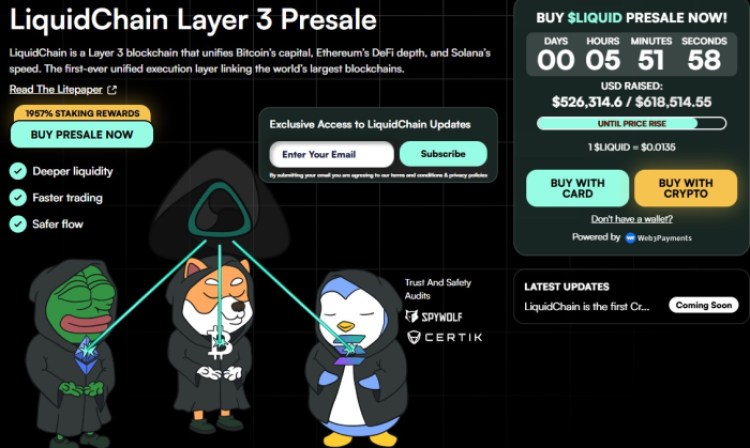
The inflow into $LIQUID suggests investors are hedging against market stagnation by backing fundamental tech upgrades. The project’s value proposition extends beyond simple governance; the token acts as transaction fuel and staking collateral. By incentivizing providers to stake assets in cross-chain pools, LiquidChain aims to generate deep, efficient markets from day one.
Financial data indicates that infrastructure projects launching with functional utility—specifically those fixing liquidity efficiency—tend to outperform pure governance tokens during recoveries. The current raise demonstrates that despite broader market fear, liquidity is available for projects with a clear technical moat.
As the presale progresses, the window for this entry price narrows, creating urgency among early adopters.
This article is for informational purposes only and does not constitute financial advice. Cryptocurrencies are high-risk assets; always conduct independent research before investing.