27 January 2026
A panel of XRP-focused commentators is leaning heavily into Davos optics as evidence that BlackRock and Ripple are converging on a shared vision for tokenized finance, even as none of the participants produced direct confirmation of a formal partnership between the two firms.
BlackRock, Ripple And XRP After Davos
Host Versan Aljarrah opened by pointing to “BlackRock and Brad Garlinghouse at Davos,” asking guest Jake Claver what he took from their presence and the “conclusion they had over there.” Claver’s answer centered on what he said he heard from BlackRock CEO Larry Fink about settlement consolidation.
“He mentioned that it would be ideal if everything was on one blockchain or at least settled back to one blockchain,” Claver said. “For Ripple to be in the room and having been in the room for years at this point, it gives me you know a lot of confidence that it is the XRPL […] I feel like BlackRock and Ripple are much more involved than people realize.”
Today we’re joined by @beyond_broke to discuss BlackRock’s quiet ties with Ripple, the soft disclosures around XRP, and the future of digitization and tokenization.
Excited to have everyone back together for this one.https://t.co/oMHGWqMehB pic.twitter.com/u1s7LyOAhs
— Black Swan Capitalist (@VersanAljarrah) January 26, 2026
Aljarrah immediately widened the claim beyond Davos stagecraft, asserting, “it’s quite obvious at this point that Blackrock, JP Morgan, Ripple and all these major banks they have some ties to Ripple [and] XRP,” before returning to the recurring theme that Davos access itself is a filter. Later, he argued that the set of crypto-native executives allowed near institutions like the WEF and BIS was narrowing and that Garlinghouse’s inclusion mattered more than “headline hype.”
David (Digital Outlook) pushed the discussion toward implementation, but repeatedly brought BlackRock back into the frame as a connective thread in Ripple’s institutional strategy. “When it came out to like, okay, has Ripple really positioned themselves to be like […] the main leader in the space […] with the acquisitions that they’ve made […] custody with Palisade,” he said. “I think they got Metaco and Standard Custody in there […] clearance through Hidden Road, all that. Then […] you see all these other linkages between their partners like what they’re doing with Blackrock. You know, they’ve got some stuff going on there.”
A second line of argument was that BlackRock’s eventual entry could be the trigger for an XRP liquidity event. Edo Farina framed it in “order size” terms: “It takes one huge institutional order from a Blackrock a great scale and that’s it,” he said, claiming market pricing can stay muted if institutional positioning happens through OTC arrangements.
Claver added: “When Blackrock steps in, there will be likely a supply shock that allows XRP to decouple from the rest of the crypto market and Bitcoin,” and tied that idea to a viral episode the panel said briefly moved XRP out of sync with the rest of crypto. “We’ve seen it decoupled once […] when […] the [fake] trust that had been filed in Delaware for Blackrock’s iShares XRP ETF […] hit Twitter,” Claver said.
Still, BlackRock’s observable crypto footprint still tilts towards Ethereum and Bitcoin rather than XRP. BlackRock’s flagship US spot exposure is via products tracking bitcoin and ether, IBIT and ETHA, while its tokenization beachhead has also been Ethereum-first: BlackRock’s BUIDL fund debuted on Ethereum via Securitize in March 2024, and only later expanded to additional networks.
Also, BlackRock’s own 2026 thematic outlook is explicitly naming Ethereum as the infrastructure layer that “collects the toll” as tokenization scales, with stablecoins treated as an early proxy for tokenization “in action.” BlackRock highlights data indicating “65%+” of tokenized assets sit on Ethereum, an argument for why “one blockchain” speculation often defaults to ETH in institutional circles.
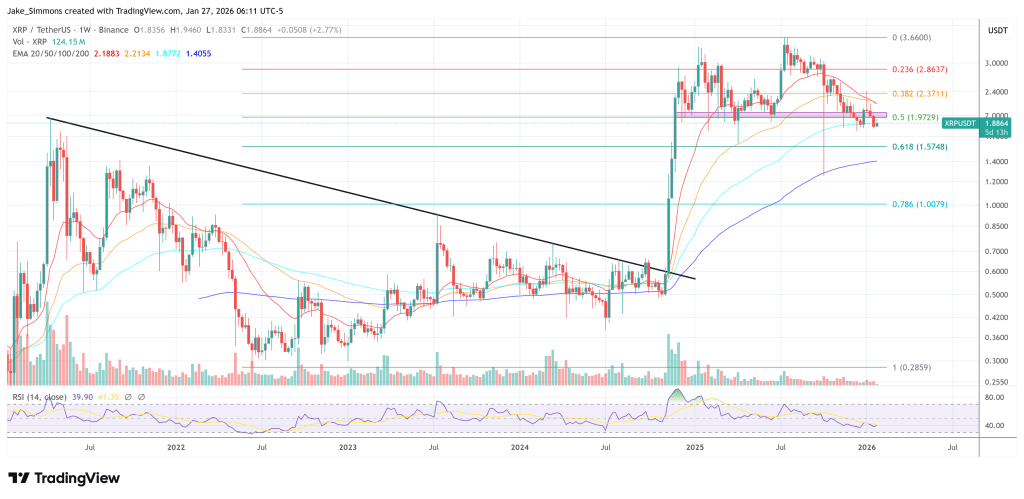
At press time, XRP traded at $1.88.